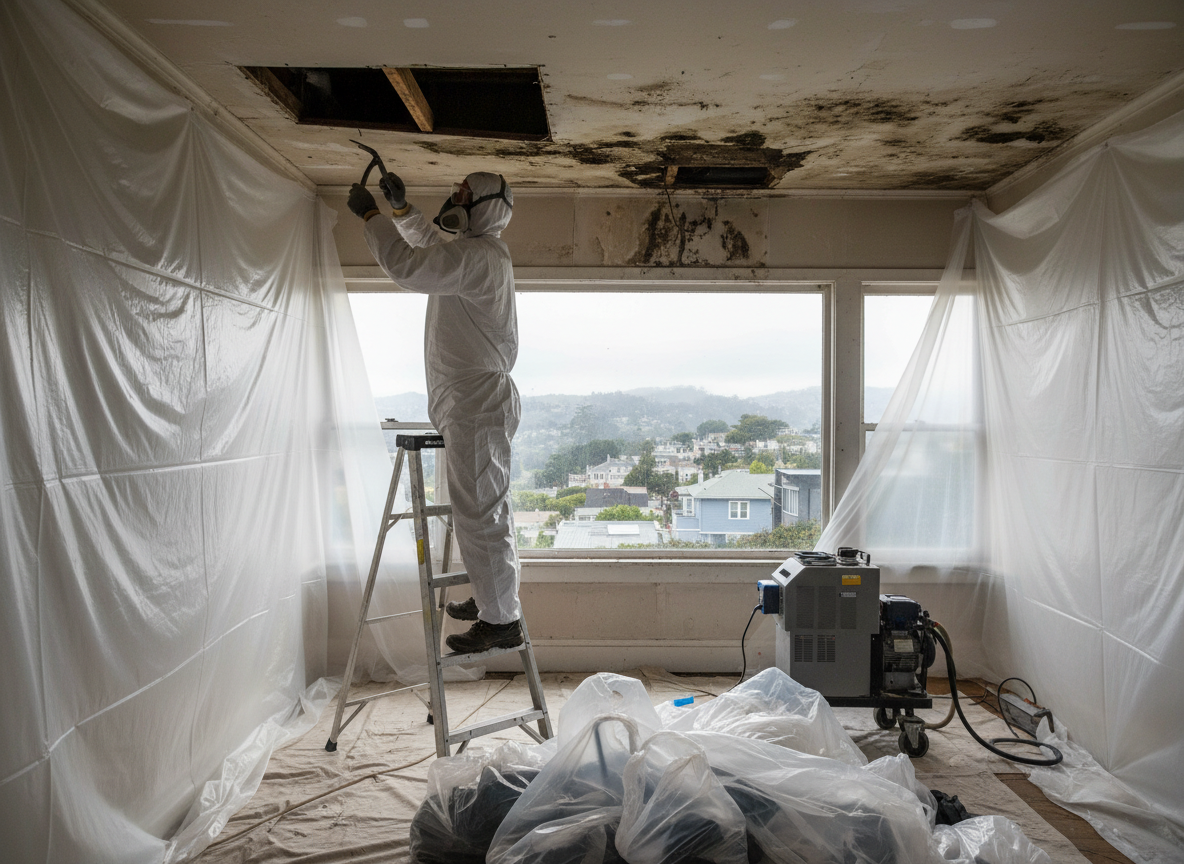
Twin Peaks sits in San Bernardino County at elevation where heavy winter snow loads often push water under roof edges and into attics of 1960s-1980s cabins. When that melt refreezes and thaws again, it soaks insulation and sheathing that rarely dries before the next storm. Abatement crews must pull back drywall or paneling in tight roof spaces while containing spores so they do not drift into living areas below. Containment barriers and negative air machines become essential because many homes lack the open floor plans that make airflow easy to manage.
The local building stock mixes A-frame chalets with post-and-beam construction; both trap moisture behind tongue-and-groove ceilings and under layers of asphalt shingles added over decades. Removing visible mold without disturbing the original knotty pine or cedar finishes requires careful surface cleaning and, when necessary, replacement of only the affected boards rather than full ceiling demo. Homeowners in Crestline and Lake Arrowhead frequently discover the same issue after spring runoff saturates crawl spaces that sit directly on native granite and decomposed granite soils with poor drainage.
During abatement, technicians test moisture content in framing members because residual dampness above 16 percent will allow regrowth once temperatures rise again in summer. In Twin Peaks the short warm season means any missed damp spots have only a few months to dry before the next freeze-thaw cycle begins. Proper disposal of contaminated materials follows San Bernardino County landfill rules for construction debris, and crews document each step so owners can show insurers the source of the water intrusion was corrected.
After removal, source correction often involves adding ridge vents or improving gutter extensions on steep driveways where snowplows pile drifts against foundation walls. These steps prevent the repeat calls that occur when only the mold is treated and the leak path remains open.
Technician insight
In Twin Peaks the thing that catches most people out with mold abatement is snow melt running under the fascia on north-facing slopes; the water travels along the top plate for months before anyone notices the musty smell inside. Older cabins here rarely have ridge vents, so once the leak starts it stays wet through the long cold season.
Hidden Attic Growth After Heavy Snow
A Twin Peaks homeowner noticed a musty odor in the upstairs bedroom after an unusually wet winter. Inspection found water had entered along the north eaves, soaking fiberglass batts and the back side of cedar paneling. Crews contained the attic, removed the wet insulation, cleaned the sheathing, and added temporary ridge venting until permanent repairs could be made. Follow-up testing showed moisture levels below 12 percent with no detectable spores remaining.
How it works
- 1
Inspection and Moisture Mapping
Technicians walk the property with moisture meters and thermal cameras to locate hidden damp areas created by snow melt or ice dams common in Twin Peaks winters.
- 2
Containment Setup
Plastic barriers and negative air machines isolate the work zone so spores do not spread through the small, closed floor plans typical of mountain cabins.
- 3
Removal and Cleaning
Affected drywall, insulation, and wood are removed or HEPA-vacuumed and treated with EPA-registered antimicrobials suited to the local climate conditions.
- 4
Drying and Verification
Industrial dehumidifiers and air movers dry the structure; post-remediation testing confirms moisture levels stay below thresholds that allow regrowth.
Pricing
Cost depends on square footage affected, access difficulty in steep-roof homes, and whether insulation or structural wood must be replaced.