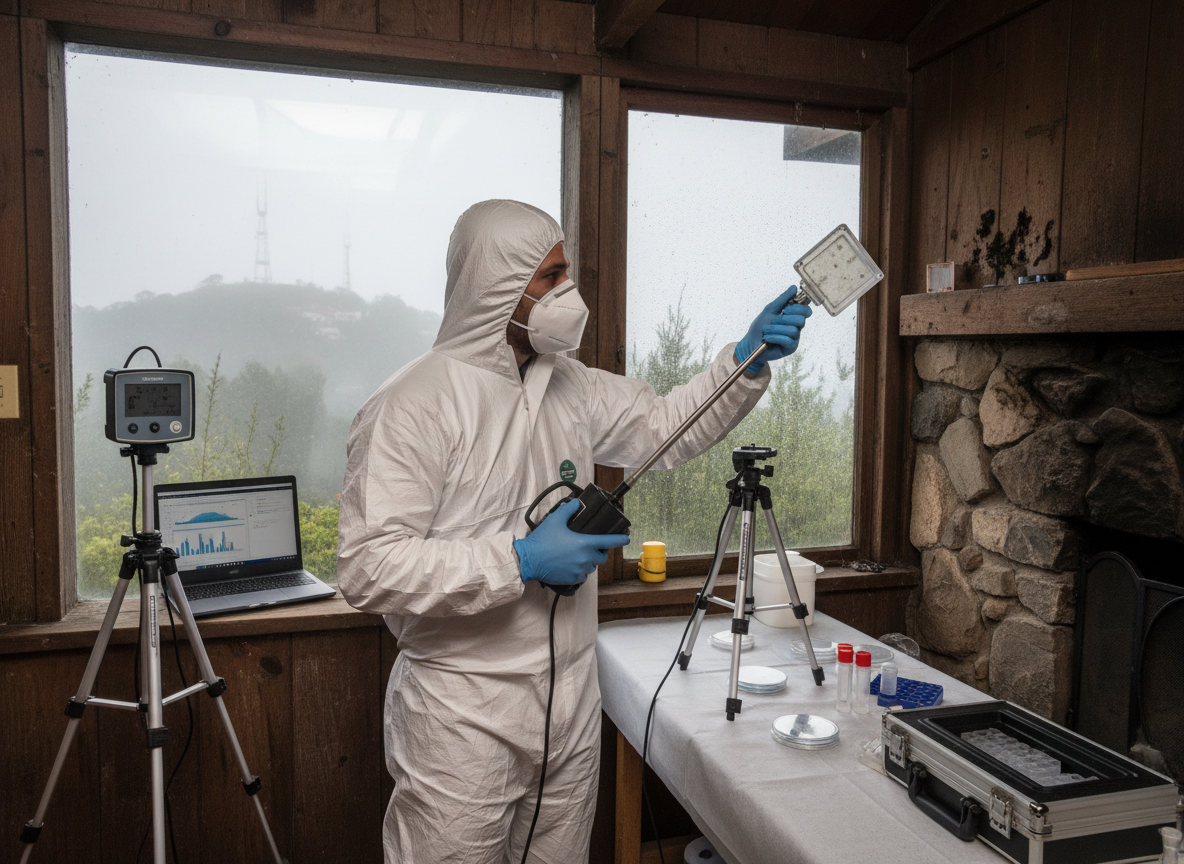
Twin Peaks sits in the San Bernardino Mountains where cold snowy winters and warm summers create repeated freeze-thaw cycles. These cycles push moisture through rooflines, attic insulation, and crawl spaces in older cabins and A-frame homes common along Highway 189. Mold spore testing here focuses on both air sampling in living spaces and surface lifts from attic sheathing or subfloor boards where meltwater often collects unseen.
Homes near Lake Arrowhead and Crestline frequently share the same construction details: single-pane windows, limited ventilation, and original cedar siding that holds moisture after heavy winter storms. Spore testing protocols must distinguish between outdoor mountain pollen loads and indoor amplification caused by ice-dam leaks or bathroom exhaust fans venting into cold attics. Technicians run multiple outdoor control samples because the surrounding forest contributes high baseline spore counts that can mask interior issues if not properly compared.
Testing also accounts for the rapid temperature swings that occur when daytime sun hits south-facing slopes while north sides remain shaded and frozen. This differential drives condensation on ductwork and behind drywall. Reports include spore type identification and concentration ratios so homeowners in Twin Peaks can see whether remediation is limited to one room or requires broader attic and crawl-space attention before the next snow load arrives.
Technician insight
In Twin Peaks the thing that catches most people out with mold spore testing is the high outdoor spore load from the surrounding forest during spring melt. Homeowners assume any reading means an indoor problem, but without proper outdoor controls the numbers get misread and unnecessary remediation gets recommended.
Attic Spore Spike After Heavy Snow
A Twin Peaks cabin showed elevated spores in second-floor bedrooms after a late-winter storm. Testing located the source to ice-dam leaks at the north roof edge where meltwater had soaked into original insulation. Additional attic samples confirmed the amplification zone while outdoor controls remained typical for the area. Targeted removal of affected insulation and improved ridge venting resolved the readings.
How it works
- 1
Initial Property Walkthrough
Technician inspects Twin Peaks home exterior for roof leaks, ice-dam evidence, and grading issues common on sloped mountain lots, then maps interior moisture-prone zones.
- 2
Air and Surface Sampling
Collect outdoor baseline samples plus indoor air cassettes and tape lifts from drywall, insulation, and subfloor areas where snow melt typically enters.
- 3
Laboratory Analysis
Samples sent for spore identification and count comparison, with results cross-checked against local mountain forest baselines.
- 4
Detailed Report and Recommendations
Written findings delivered with location-specific notes on attic ventilation, crawl-space conditions, and seasonal moisture risks in San Bernardino County mountain homes.
Pricing
Cost depends on number of samples, square footage, and whether crawl space or attic access is required; upfront quote provided before work begins.