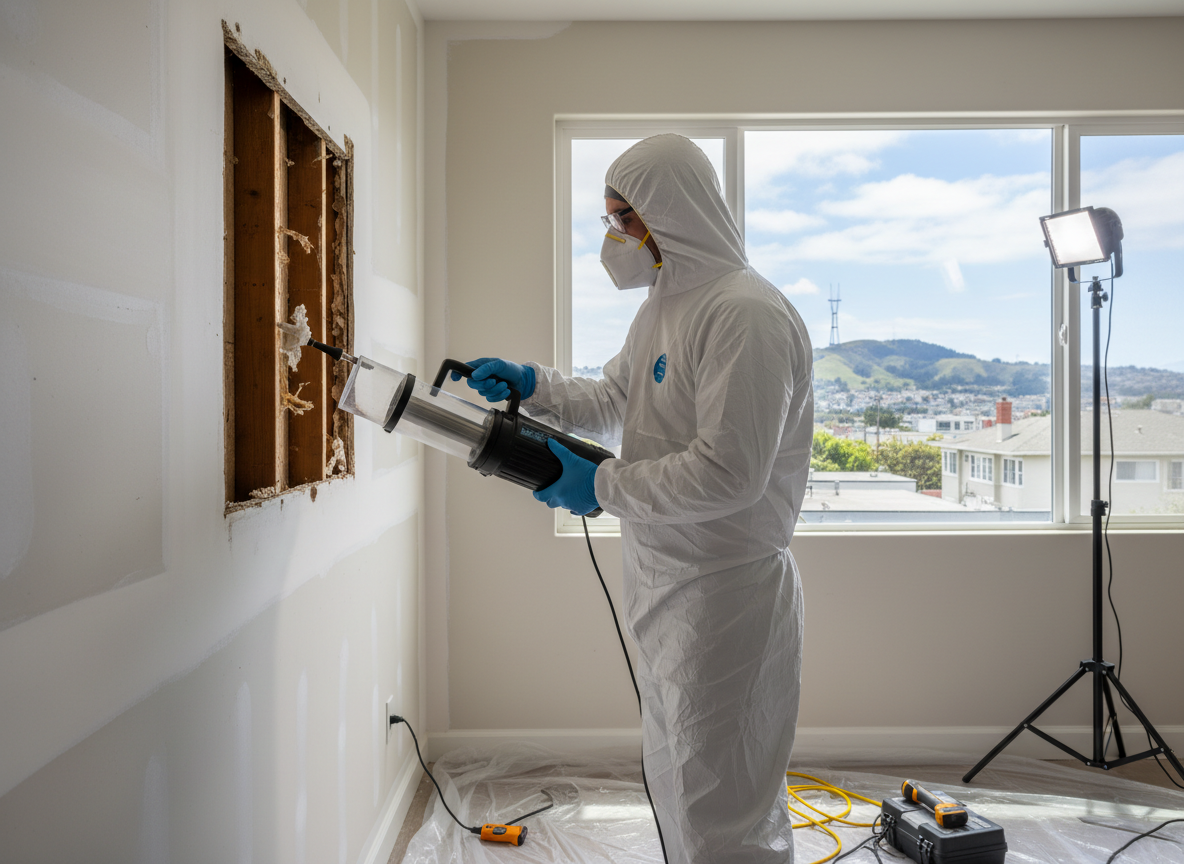
Post remediation mold testing in Twin Peaks requires air and surface sampling after all visible mold and affected materials have been removed. Technicians collect samples from multiple rooms plus the HVAC system because mountain winters drive condensation in attics and crawl spaces when warm indoor air meets cold roof decks. Results are compared against outdoor baseline samples taken the same day to account for natural spore levels common in San Bernardino County forests.
Homes in Twin Peaks and nearby Crestline often date from the 1960s through 1980s with limited insulation and older vapor barriers. These conditions allow residual moisture from spring snow melt to remain trapped behind walls or under subfloors even after initial drying. Testing protocols therefore include moisture meter readings at multiple depths and thermal imaging to locate hidden pockets that standard visual inspection misses.
Clearance criteria follow industry standards requiring spore counts in treated areas to match or fall below outdoor levels with no elevated indicator species. Reports detail each sample location, laboratory findings, and any areas still showing elevated moisture so homeowners know exactly what follow-up work, if any, is needed before moving furniture back in.
Because Twin Peaks sits at higher elevation than Lake Arrowhead, temperature swings are sharper and can reintroduce humidity within hours if dehumidifiers are removed too soon. Final testing is therefore scheduled at least 48 hours after equipment shutdown to capture real equilibrium conditions rather than temporary dry readings.
Technician insight
In Twin Peaks, the thing that catches most people out with post remediation mold testing is snow melt running under older crawl space vapor barriers during spring thaw. Homes built before 1980 along CA-189 often have dirt floors that stay damp for weeks after the last storm, so we always pull moisture readings at the footer plates even when the living space tests dry.
Crestline Road Attic Clearance
After winter pipe leak repairs in a 1972 home near Twin Peaks, the owner requested clearance testing. We found elevated Penicillium in the attic despite new insulation. Additional drying and HEPA vacuuming of rafters brought counts in line with outdoor controls, allowing the family to finish the remodel without further issues.
How it works
- 1
Site Walk and Sampling Plan
Technician reviews the prior remediation scope, then marks air and surface sample locations throughout the treated zones and unaffected rooms.
- 2
Sample Collection
Air cassettes and tape lifts are gathered from each marked spot plus HVAC returns and supplies while outdoor control samples are taken simultaneously.
- 3
Moisture and Thermal Assessment
Moisture meters and infrared scans check walls, floors, and ceilings for remaining dampness that could support regrowth in Twin Peaks winter conditions.
- 4
Laboratory Analysis and Report
Samples are sent for spore identification and counts; a written clearance report with findings and any recommended next steps is delivered within 48 hours.
Pricing
Cost depends on square footage tested and number of samples required; most Twin Peaks homes need four to eight samples for reliable clearance data.