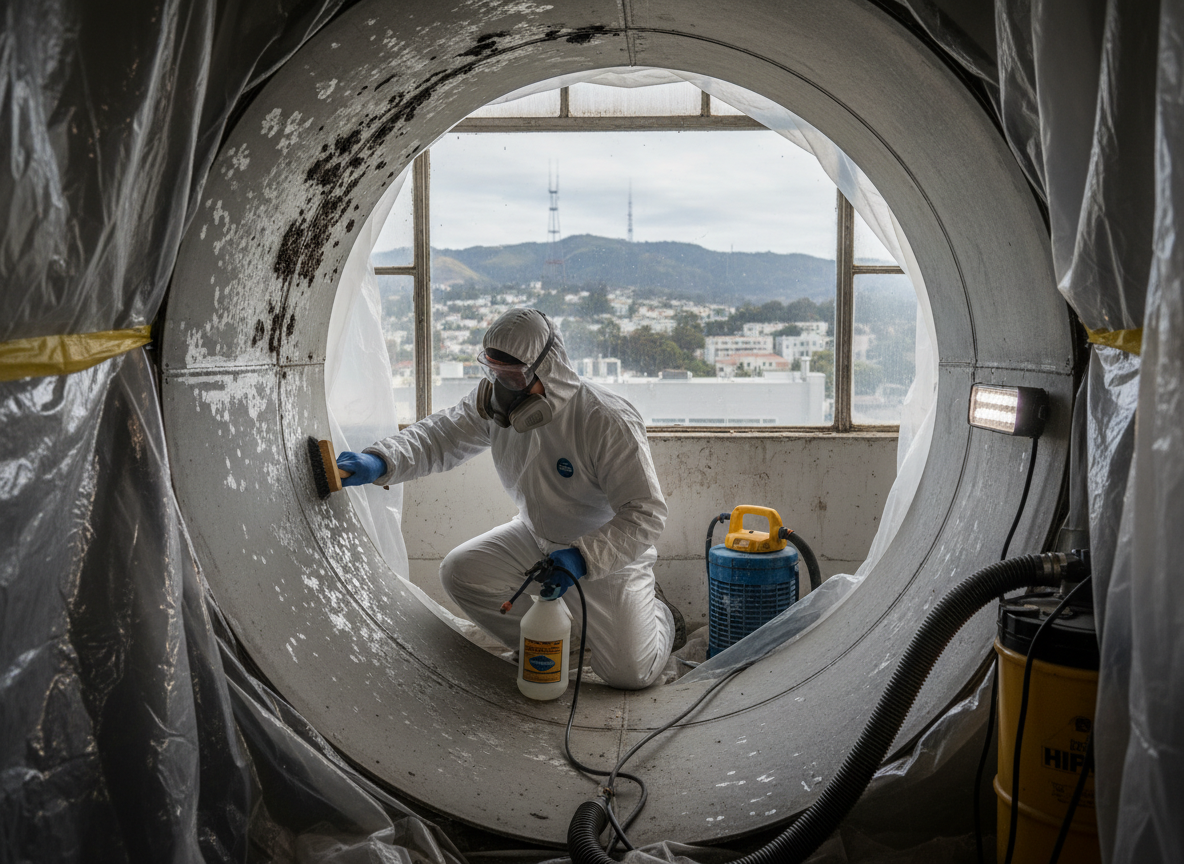
Twin Peaks sits at elevation in San Bernardino County with heavy winter snow loads that melt into attics and crawl spaces. This moisture travels through HVAC ducts and ridge vents, feeding mold on insulation and metal surfaces that standard cleaning misses. Older cabins and mid-century homes common here often have undersized or uninsulated duct runs that stay damp for weeks after storms.
We isolate the affected trunk lines and return runs first, then use negative air machines sized for the square footage of these mountain properties. Containment barriers go up around registers in living spaces because the steep terrain makes full-home evacuation impractical for many residents. After source removal we fog with EPA-registered antimicrobials formulated for cold-weather condensation cycles, not the coastal products that fail here.
Final clearance includes borescope inspection of every accessible elbow and boot plus moisture readings logged against the current snowpack data from nearby Lake Arrowhead. Homeowners receive a written map of every vent we treated so future winter maintenance can focus on the real problem areas rather than guessing.
Seasonal guidance: schedule checks after first thaw in Crestline and Twin Peaks proper, before summer humidity spikes allow regrowth in poorly sealed soffit vents.
Technician insight
In Twin Peaks the thing that catches most people out with ventilation mold remediation is the way snow melt runs along uninsulated ridge vents straight into the main return plenum. Homeowners keep replacing filters thinking it's just dust when the real issue is repeated winter wetting that only shows up once we pull the first elbow.
Attic Return Vent in Twin Peaks Cabin
Heavy spring melt from the 2023 snowpack sent water along the ridge vent into the main return trunk. We isolated the attic, removed saturated insulation and two sections of flex duct, treated the metal boot, and verified clearance before the next cold front arrived.
How it works
- 1
Initial Containment and Isolation
Set up negative pressure zones around the HVAC system using 6-mil poly barriers taped to framing, protecting living areas in compact Twin Peaks lots.
- 2
Source Removal
Remove contaminated insulation, flex duct sections, and vent boots while HEPA vacuuming all hard surfaces inside the ductwork.
- 3
Antimicrobial Application
Apply targeted antimicrobial fog through the entire ventilation network, focusing on cold spots where snow melt creates repeated wetting.
- 4
Clearance Testing
Perform visual inspection, moisture metering, and air sampling before restoring full system operation.
Pricing
Upfront quotes after on-site inspection; cost driven by number of trunk lines, accessibility on sloped lots, and extent of insulation replacement.